
In God we trust coin value is a broad phrase. It does not point to one coin. It points to a motto that appears on many U.S. issues. That is why the motto alone does not create a fixed price. Collectors need a narrower question: which coins were first, which types matter, and when does the motto affect collector value in a real way? The U.S. Mint states that the two-cent coin was the first to use the inscription, and its historical timeline says this was the first time the motto appeared on a coin.
Why the Motto Itself Does Not Create Value
The motto appears on a large part of U.S. coinage. That means the words alone do not make a coin scarce. Value comes from the coin itself:
- Denomination
- Date
- Mint mark
- Metal
- Subtype
- Grade
- Surface quality
A common modern coin with the motto is still common. An early two-cent piece is different. A gold coin that exists in both No Motto and With Motto forms is different again. The motto matters when it helps define a first issue, a recognized subtype, or an error.
This is the first rule for the topic. Do not price the phrase. Price the coin. That removes a lot of noise from seller titles and inflated listings.
The First U.S. Coin With “In God We Trust”
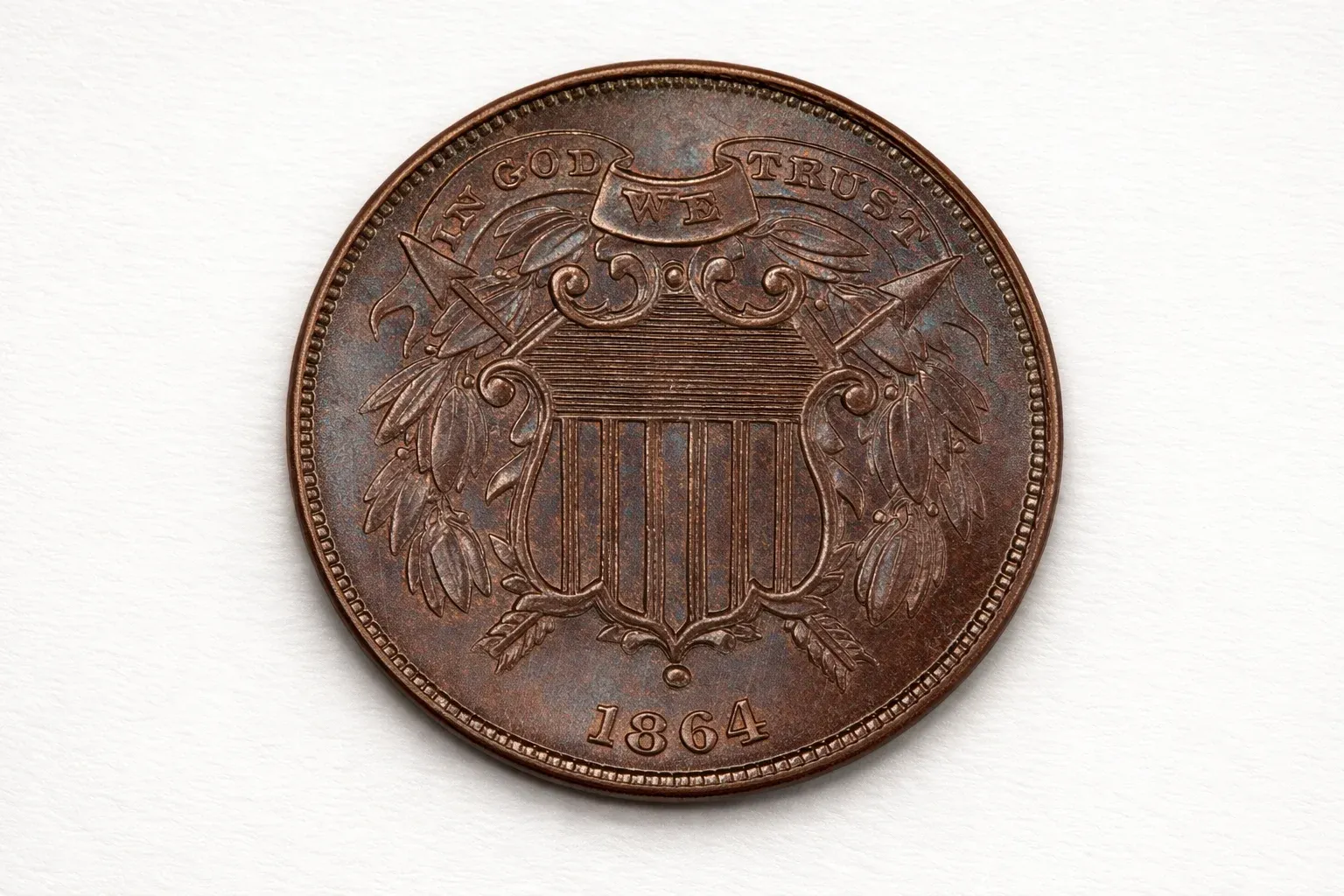
The first regular U.S. coin with IN GOD WE TRUST was the bronze two-cent piece of 1864. It was not a minor design change. It marked the first appearance of the motto on federal coinage. The type was designed by James B. Longacre. The obverse shows a shield with a ribbon above it carrying the motto. The reverse shows a wreath around the denomination.
Basic facts about the first motto coin
| Item | 1864 Two-Cent Piece |
| First use of IN GOD WE TRUST | Yes |
| Metal | Bronze |
| Mint | Philadelphia |
| Diameter | 23.00 mm |
| Weight | 6.22 g |
| Designer | James B. Longacre |
This table uses U.S. Mint history for the “first use” point and PCGS for the basic coin specifications.
The coin matters for two reasons. First, it is the starting point of the motto on U.S. coins. Second, it is a real collector series. It has subtype differences, proof issues, color designations, and a clear value structure. That gives the coin more depth than the search phrase suggests.
Small Motto and Large Motto
Collectors cannot stop at “1864 two-cent piece.” The year splits into two main motto styles: Small Motto and Large Motto. This is one of the first places where the motto affects value in a practical way. PCGS treats them as separate issues. The Small Motto is scarcer, while the Large Motto became the permanent design choice for the rest of the series.
1864 Small Motto vs Large Motto
| Type | Why collectors separate it | Approximate market logic |
| 1864 Small Motto | First-year scarcer subtype | Higher demand, stronger prices |
| 1864 Large Motto | Standard motto style for the series | More available, lower entry cost |
For Mint State Brown coins, the 1864 Small Motto runs about $110 to $4,400, while the 1864 Large Motto Brown runs about $12 to $6,000. That does not mean every Large Motto is cheap. It means the Small Motto starts stronger, while the Large Motto builds value more slowly and becomes scarce mainly as a gem.
The same pattern appears in proofs. PCGS lists only 30 proof 1864 Small Motto pieces and 100 proof 1864 Large Motto pieces. That is another reason the Small Motto holds more attention.
What changes the price of 1864 two-cent pieces
- Exact subtype
- Brown, Red-Brown, or Red color
- Proof or regular strike
- Grade
- Surface quality
- Eye appeal
This is why the motto matters here. It is not just a phrase. It marks a subtype that the market separates and prices differently.
How the Motto Spread after 1864
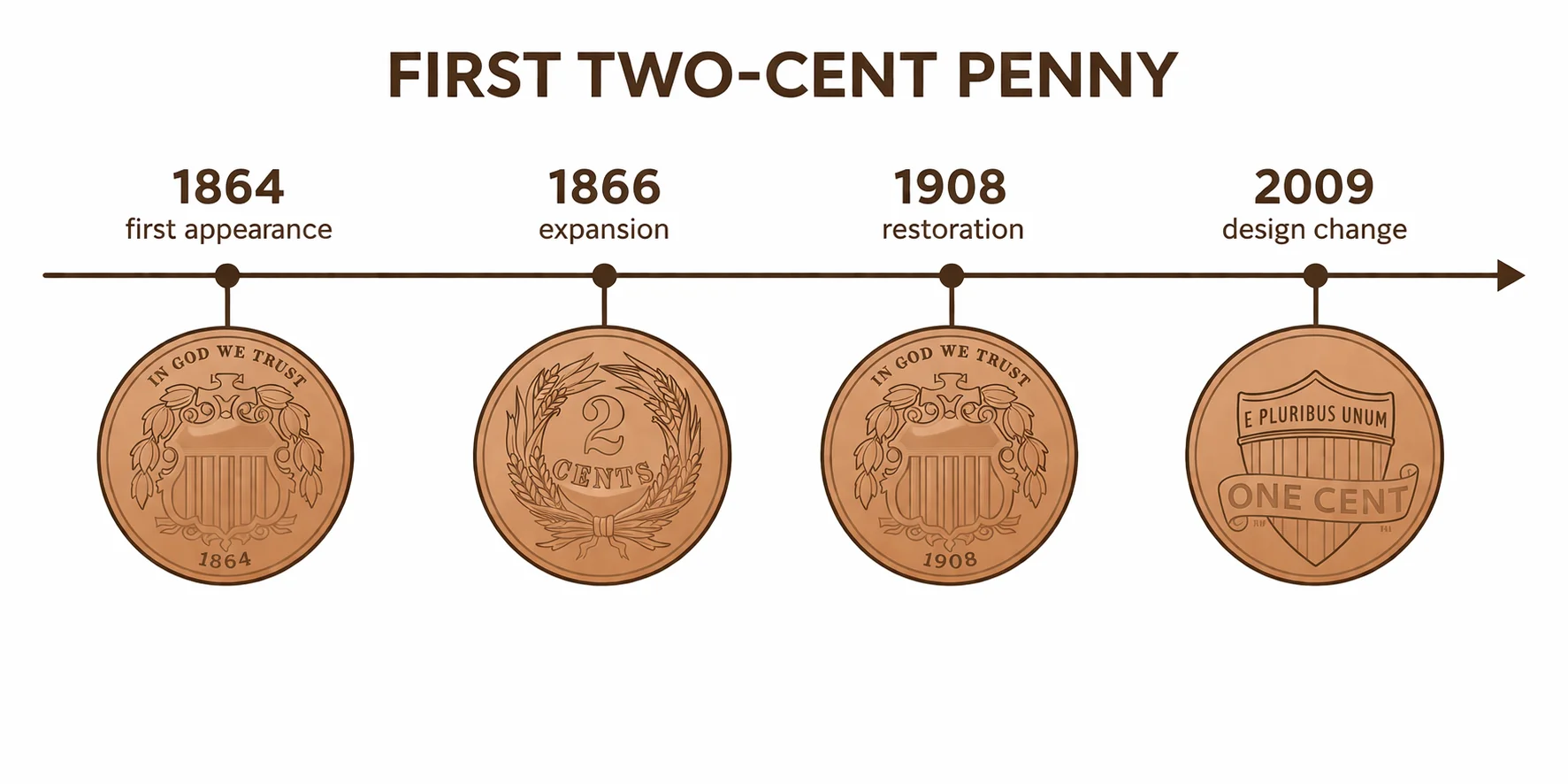
The story did not stop with the two-cent piece. The U.S. Mint’s official document on the restoration of the motto states that the inscription was first placed on gold and silver coins on January 1, 1866, with the dime excluded because it was too small. This is the second stage of the story. The motto moved from one bronze denomination into the larger coinage system.
Early expansion of the motto
| Stage | Date | What changed |
| First appearance | 1864 | Motto placed on the bronze two-cent piece |
| Expansion | 1866 | Motto placed on gold and silver coins, except the dime |
| Restoration era | 1908 | Congress restores the motto on denominations that had carried it before |
This table shows why the topic is broader than one coin. The 1864 issue is the first coin. The 1866 change shows the motto becoming part of the national coin design. The 1908 act matters because it turned the motto into a major subtype marker again.
Why 1908 Still Matters to Collectors
The 1908 act restored IN GOD WE TRUST on the coins where it had appeared before. That matters because it created famous subtype splits on early 20th-century gold. The best-known examples are Saint-Gaudens double eagles and Indian Head eagles in No Motto and With Motto form.
The U.S. Mint’s restoration document states that the act took effect thirty days after passage and that the motto appears on all gold and silver coins struck since July 1, 1908, except the dime. PCGS treats these 1908 gold issues as real type distinctions.
Later Motto-Based Types Collectors Know Well
| Type | Why it matters |
| 1864 2-Cent Small Motto | First motto subtype and scarcer than Large Motto |
| 1864 2-Cent Large Motto | Standard type for the date |
| 1908 $20 No Motto | Famous gold subtype |
| 1908 $10 With Motto | Recognized gold subtype after restoration |
This is the wider collector angle. The motto first mattered because it appeared. Later, it mattered because it divided types into collectible subgroups.
When the Motto Matters Because It Is Missing
There is a modern angle, too. On Presidential dollars in 2007 and 2008, IN GOD WE TRUST was part of the edge lettering. The U.S. Mint announced that, beginning in 2009, the motto would appear on the obverse of Presidential dollars. That is important because it explains the famous “missing edge lettering” coins from the earlier years. In those cases, the motto matters because it is absent, not because it is present.
This is a different market from the two-cent piece. It is not about the first issue. It is not about a gold subtype. It is about an error-style situation tied to edge lettering. Still, it fits the same rule: the motto affects value only when it helps define something specific.
Collector Value: What Actually Matters
A practical value discussion should stay simple.
Value drivers for early motto coins
- First-issue status
- Subtype strength
- Grade
- Color on bronze coins
- Proof status
- Demand from type collectors
A free coin value checker can help with the first step. It can show that proofs sit in a different price bracket and other nuances. But it cannot replace subtype knowledge and surface review. Early motto coins need correct attribution first. Then the price range starts to make sense.
Practical reading of the market
| Coin | Low-end collector reality | Stronger collector level |
| 1864 Small Motto | Low hundreds in lower collector grades | Several thousand in Mint State Brown, more in better color |
| 1864 Large Motto | Much lower entry level | Builds value mainly in higher grades |
| 1864 proofs | Separate market | Small Motto proofs are stronger and scarcer |
These are broad working ranges, not fixed prices. They reflect the structure shown by Greysheet and the proof mintages shown by PCGS.
Before You Buy
For this topic, a short checklist helps more than a long theory block.
- Confirm the denomination
- Confirm the date
- Separate Small Motto from Large Motto
- Check proof vs regular strike
- Review color and surfaces
- Do not pay for the words alone
This matters most on the 1864 two-cent piece. Many buyers see an old coin with the motto and stop there. That is not enough. The stronger question is narrower: which subtype is it, what condition is it in, and where does it sit in the real market?
Final View
The first U.S. coin with IN GOD WE TRUST was the 1864 two-cent piece. That is the starting point. The 1864 Small Motto and Large Motto split gives the topic its first real subtype market. The spread of gold and silver in 1866 gave the motto a wider place in U.S. coinage. The 1908 restoration makes it important again in famous gold types. The 2009 Presidential dollar change shows that the motto can still shape collecting even in modern coins.The main lesson is simple. The motto does not carry a price by itself. The coin does. Type, subtype, grade, color, proof status, and collector demand do the work. At the first-pass stage, a coin identification app such as Coin ID Scanner can help with quick coin cards, Smart Filters, and an AI helper, but early motto coins still need direct inspection and correct attribution. That is where collector value starts.
